Lakesco Submersible, Milford, Connecticut:
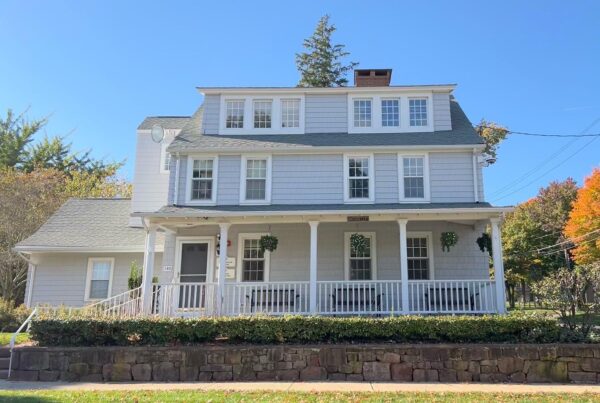
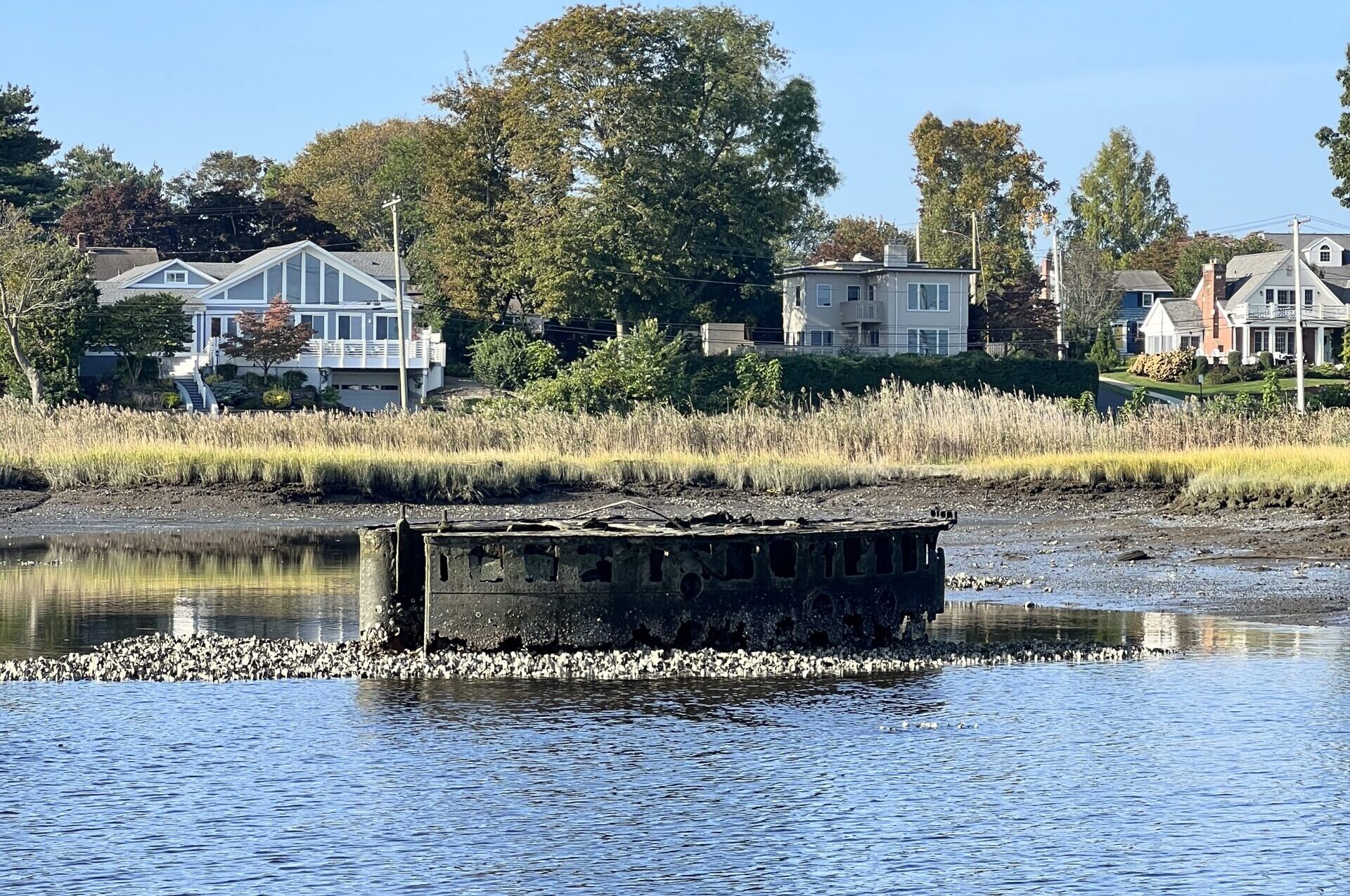
On Rogers Avenue in Milford are two identical Colonial Revival houses built in 1915 for the daughters of Simon Lake – a submarine inventor who lived in Milford. The story behind these homes involves one of Lake’s shipwrecks located directly across the street. There on a mudflat, between Port Milford Marina and the mouth of Beard’s Creek, is an abandoned submersible called the Lakesco.
The rusty wreck can be seen at low tide. It’s about a century old, having been manufactured in the 1920s by the Bridgeport-based Lake Torpedo Boat Company. Unlike a submarine, the salvage vessel was a submersible. Instead of propelling itself through water, the Lakesco was lowered underwater by a mothership, rolled along the seafloor on wheels and accessed via a tube-shaped staircase about 200 feet long.


It’s maker, Simon Lake, was born in 1866 in Pleasantville, New Jersey. He grew up captivated by Jules Verne’s science fiction novel, Twenty Thousand Leagues Under the Sea. Despite dropping out of preparatory school and college, Lake honed his mechanical engineering skills by working alongside his father, J. Christopher Lake, at The Old Mill in Toms River, New Jersey.
The Lake’s were a family of ambitious inventors and risk takers. Simon’s grandfather devised a seed planting machine, his father contrived a window shade roller and his cousin developed a telephone.

Simon Lake
The young, redheaded Simon Lake tinkered towards his own ultimate goal: to create practical submarines. According to his autobiography, he was fourteen years old when he completed plans for his first submarine. Then in 1894, at 28, he built and tested an underwater craft which he named Argonaut Junior.
The wooden submersible travelled the sea bottom on wheels turned by hand. Lake and his cousin, Bart Champion, operated the vessel. Argonaut Junior’s first plunge awed onlookers around Sandy Hook, New Jersey on January 8, 1895. Lake had successfully demonstrated the first full-sized submarine in the United States.
“The boat was a tiny affair, perhaps fourteen feet long, roughly in the shape of a flat-iron mounted on wheels, flat-sided and flat-bottomed. She had a double skin of yellow pine, with canvas between the skins, and was well calked and payed. A propeller was operated by a man-power crank, pur compressed-air reservoir was a tank from a bankrupt soda-fountain, and the pump for compressing air had begun life as a plumber’s hand-pump.” -Submarine: The Autobiography of Simon Lake

Simon Lake poses with Argonaut I, 1898.
Four years later, he captained a larger vessel named Argonaut I on a thousand mile dive from Norfolk, Virginia, to Sandy Hook, New Jersey. It was the world’s first submersible to traverse open sea.
The feat prompted Jules Verne to send Lake a congratulatory telegram. In his message, Verne predicted the use of submarines as machines of war:
“Submarine navigation is now ahead of aerial navigation and will advance much faster from now on. Before the United States gains her full development she is likely to have mighty navies not only on the bosom of the Atlantic and Pacific, but in the upper air and beneath the water’s surface.” -Jules Verne, 1894.

A drawing depicting Simon Lake’s submersible, 1900 (c.)
In 1901, Lake professionalized his submariner expertise, incorporating Lake Torpedo Boat Company. The concern included a large shipyard in Bridgeport, Connecticut. He supposedly chose the Connecticut Shoreline for its ease of access to the Long Island Sound and the Atlantic Ocean.
Lake frequented the Nutmeg State as early as 1900 and moved to Milford on a permanent basis in 1907. At 135 Broad Street, he toiled inside an inventor’s workshop behind his large Italianate style home.

Simon Lake’s workshop in 2020 (now demolished).
The United States Navy took notice of Lake’s accomplishments, but in a temporary blow, they elected to work with his rival instead – John P. Holland, part owner of Electric Boat Company in Groton, Connecticut. The Naval committee voted in favor of Holland because Lake submitted only designs, and did not guarantee construction of the vessel due to a lack of resources.
An embittered Lake sold his designs to the Soviet Union in 1904 and moved to Russia for a few years with his wife, Margaret. While keeping in contact with firms in America, he partnered with Newport News Shipbuilding in Virginia to construct five submarines for the Soviet Union amid the Russo-Japanese War.

Argonaut I designs by Simon Lake.
During Lake’s stay abroad he also worked for Germany’s Kaiserliche Marine and the Austro-Hungarian Navy. Perhaps as public relations strategy for having worked for the Germans before World War I, he later accused Germany of stealing his patents to create the infamous U-boat.

USS Seal (G-1), the first Navy sub by Lake Torpedo Boat Company, 1911.
Lake eventually returned to Connecticut and expanded operations in Bridgeport. He finally won contracts to build subs for the United States Navy. Along with more than a hundred employees, Lake designed, manufactured and subcontracted 26 Navy submarines between 1911 and 1925. Launching of the USS S-2 Navy Sub by Lake Torpedo Boat Company, Bridgeport, CT, 1919.
While engaged with the Navy, Lake continued to build submersibles for purposes of exploration and discovery. This included an Arctic exploration in 1931.
The scientific expedition was sponsored by William Randolph Hearst aboard a sub named the Nautilus. The expedition met treachery and mixed results, but it became the world’s first vessel to submerge beneath polar ice caps.

Simon Lake’s Nautilus submarine (formerly USS O-12), 1931.
After a lifetime of innovation, Simon Lake passed away at 78 on June 23, 1945, having registered over two hundred patents. He was one of the fathers of modern submarine technology. He introduced several mechanized devices, including even-keel submarines, airlocks, hydroplanes, ballast tanks and periscopes.
The United States Navy named a submarine in his honor. USS Simon Lake (AS-33) was in service between 1964 and 1999.

Simon Lake (c.) 1930.
Simon Lake’s last submersible was named the Explorer. That vessel, designed to comb and claw the seafloor, is preserved and on display at the entrance to Milford’s Lisman Landing.
Meanwhile the Lakesco sits stuck in murky waters. It can be speculated that Simon Lake or his son Thomas Alva Edison Lake scuttled the Lakesco. (As his name foretold, Thomas was an inventor of hydroplane speed boats.)
Perhaps the Lakesco was placed intentionally across the street from Simon’s daughters, Miriam and Margaret, as a reminder of their father and the father of the submarine.
Learn more about Simon Lake: Simon Lake & John Holland: New Jersey’s Submarine Inventors
View post on Instagram: https://www.instagram.com/CyzPlH-sMM3
With Milford’s Washington Bridge in the background, Thomas Alva Edison Lake demonstrates his Pontoon Hydroplane: https://www.youtube.com/watch?v=BFbio1BZd4g
Sources:
- Science Fiction Inspired Inventor Simon Lake by Carol W. Kimball; The Day, New London, CT, February 26, 1998.
- Diving for $4,000,000 by Ruth Reynolds; Daily News, New York, NY, March 16, 1930.
- The Pleasantville Boy Who Invented the Submarine by Franklin W. Kemp; Press of Atlantic City, Atlantic City, NJ, November 24, 1968.
- Simon Lake, Pioneer in Modern Submarine Invention by Walter L. Johnson; The Buffalo Enquirer, Buffalo, NY, April 3, 1918.
- Simon Lake, Milford’s Master Of Submersibles by Marylin May, 2020.
-
View this post on Instagram
View on Google Maps: https://maps.app.goo.gl/qegh19tLFjt4L6iQ7